TL;DR
- A startup with no blog can start fresh by mapping what its buyers already read and need to learn.
- Find content competitors by searching buyers’ exact questions in Google and AI assistants, then note what each page answers and misses.
- Build a first batch of 10 articles across problem awareness, solution comparison, and vendor choice.
- Give the blog an editorial charter, recurring topics, and one owner to keep articles useful beyond the sales pitch.
- Adapt each article for the platforms where buyers already spend time, and use their responses to shape future topics.
A Startup With No Blog Should Start From a Map of Its Market, Not a Content Calendar
“We don’t have a blog” is not a reason to wait. A blank page is not a handicap: there’s nothing to fix, only a market to read.
We asked GPT-6 Luna, Claude Sonnet 5 and Gemini 3.5 Flash Lite how a startup with no blog should start content marketing. Their answers disagreed: Gemini advised to “skip the blog (at first)” and use LinkedIn, Reddit or podcasts instead, while Claude advised writing 5 to 10 cornerstone pieces before launching one. None cited a single source, and even AI answers offer no shared method.
Start with a map of your market, then follow six steps: identify content competitors, map the ecosystem, track relevant news, plan for the funnel, run the blog as a media outlet, and distribute each piece.
Your Content Competitors Are the Sites Your Buyers Read, Not the Companies You Sell Against
A content competitor—also called a semantic competitor—is a site that answers the questions your buyers ask, whether or not it sells a competing product. It might be a review site, a media outlet, a forum or a useful tool. A buyer persona is a simple description of the kind of person you want to reach, including what they need to learn before making a purchase.
Start with 20 to 30 questions your buyers actually ask. Pull them from sales calls, support tickets, forums and conversations with prospects; keep their wording rather than rewriting every question in marketing language. If you need a starting point, use this citation audit of 10–20 buyer questions.
Then investigate each question:
- Search it in Google, and note the pages that appear—not just the site names.
- Ask the same question in the AI assistants your buyers use, and record which pages they cite or draw on.
- For each page, write down what it does well and what it leaves unanswered.
A page might explain a topic clearly but skip the trade-offs a buyer needs to weigh. Another might offer useful comparisons but leave basic terms unexplained. Record the page-level strengths and gaps; a domain name alone won’t show you what kind of answer is already available.
Keep the questions and results in a simple spreadsheet. Include the exact question, where you searched, the page title and URL, what the page covers well, and what seems missing. If several pages repeatedly answer the same type of question, that’s a sign the topic matters in your market; a gap in those answers may point to a useful angle for your own article.
Don’t use Google Search Console to find competitors. Its Search Console Performance report shows queries and pages for your own site, not other sites’ results. It can help once your site has data, but it won’t map who currently answers your buyers’ questions.
The goal isn’t to copy the pages you find. It’s to see what your audience can already learn, where existing answers fall short, and which questions deserve a clearer or more useful response.
Ecosystem Players Who Talk to the Same Buyer Persona Reveal What Your Audience Already Reads
Your market map should include everyone who already has your buyer’s attention, not just companies selling a similar product. Complementary vendors may serve the same team from another angle; agencies and consultants may advise it, while newsletters, podcasts, communities and analysts may shape what it pays attention to.
These players can show you how buyers talk about their work when they are not speaking to a vendor. Notice the words they use for recurring problems, the questions that prompt discussion, and the formats they choose to read, watch or hear.
Look for trigger events: changes that make someone start looking for a solution. For example, a new regulation, a team reorganization or a missed target might prompt buyers in a particular market to seek advice. Treat these as clues to investigate, not assumptions about every buyer.
Try this exercise: for one week, list everything your buyer reads, listens to, watches or uses for work. Include sources they check for advice as well as tools they rely on; then group the list by type and note what topics appear more than once.
Choose three players on that list that do not compete with your product. Study recent articles, episodes, reports or discussions from each one. Record the language they use, the problems that recur, the formats that draw attention and any events they connect to a need for change.
The goal is to understand the attention your startup is entering, not to imitate another player’s voice. These organizations may also become useful collaborators: a complementary vendor might co-write an article, a consultant might share expertise in an interview, or a newsletter editor might consider a guest contribution. Start by learning what they already help your audience understand.
Industry News Gives a New Blog Something to Say When Seen Through Your Audience's Lens
News coverage gives a new blog timely, useful material while saving readers the work of following every update themselves. But speed is not your advantage: large media outlets will usually report an announcement first. Your job is to explain what changed, which readers it affects, and what they can do about it.
Before writing, check whether the development matters to your audience or only sounds important in your industry. For example, a policy change might affect how a particular team handles a task; spell out the practical effect, note who may not be affected, and suggest a next step. Link to the primary source—the original announcement, rule or research—so readers can check the details for themselves.
Choose a format that fits the news. Write a short analysis when one development has clear implications, or publish a monthly roundup that groups several updates with your commentary. In either format, add context and a point of view rather than repeating the announcement.
Set news aside as a minority of your publishing calendar, alongside the evergreen articles that stay useful over time. Treat that balance as a starting point, not a fixed ratio: adjust it to your readers’ need for timely updates and your team’s capacity to respond. If an update does not change what your audience understands or does, skip it.
Map Your First 10 Blog Articles Across the Funnel, From TOFU to BOFU
TOFU (top of funnel) helps readers recognize and understand a problem. MOFU (middle of funnel) helps them compare ways to solve it, while BOFU (bottom of funnel) helps them choose a vendor. Plan articles that move readers from one decision to the next, rather than asking every reader to book a demo.
Use this first batch of 10 as a starting mix, not a fixed formula. Adapt the topics and balance to the questions your buyers ask and what your sales team needs.
| Stage | Article type | Natural next step for the reader |
|---|---|---|
| TOFU | Problem explainer: Why does [problem] keep happening? | Read an article on the cost of leaving it unresolved |
| TOFU | Cost of the status quo: What does [problem] cost a team over time? | Explore practical ways to address it |
| TOFU | How-to: How to spot early signs of [problem] | Follow a link to a guide comparing possible solutions |
| TOFU | Problem explainer: Which teams or situations are most affected by [problem]? | Read a relevant how-to |
| MOFU | How-to: How to solve [problem] with your current process | Compare that approach with other options |
| MOFU | Build vs. buy: Should you create a solution in-house or purchase one? | Review criteria for evaluating options |
| MOFU | Evaluation criteria: What should you look for in a solution? | Check pricing factors and budget considerations |
| BOFU | Pricing factors: What affects the cost of [solution type]? | Use a vendor-question checklist |
| BOFU | Questions to ask vendors before choosing a [solution type] | Read a customer story about a similar decision |
| BOFU | Customer story: How a team addressed [problem] | See whether a conversation or product walkthrough is useful |
Publish at least one BOFU article early. Sales may need a clear pricing explainer, vendor-question list or customer story now, even while broader articles are still being written.
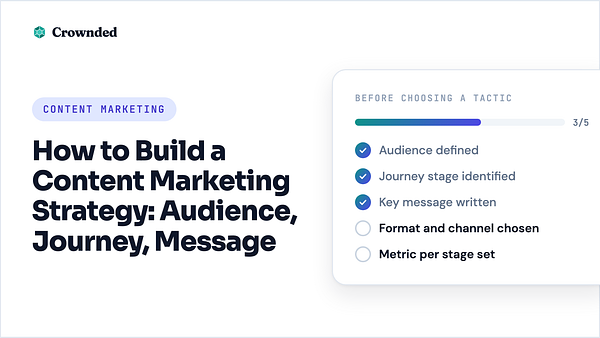
Give each article a next step that fits the reader’s stage. A TOFU reader might want a related explainer; a MOFU reader may welcome a comparison guide; a BOFU reader may be ready to contact sales. Link articles across stages so readers can continue when they want to, and use calls to action that offer—not demand—a sensible next move. For a deeper look at each stage, see how to build a content marketing strategy.
Run Your Company Blog Like a Media Outlet: Editorial Mission, Beats and Recurring Formats
A blog is a media outlet you build for an audience, not a brochure about your product. Start by deciding what readers need from it, then set clear boundaries so your team can keep delivering that value.
Write a one-page editorial charter: a short guide to whom the blog serves, what it helps them understand or do, and what belongs on it. Keep it brief enough that anyone planning an article can use it.
- Name the audience and the questions or tasks the blog will help them with.
- Choose 3 to 5 beats—the recurring topic areas the blog will cover.
- Pick recurring formats, such as a practical how-to, an expert Q&A, or an explainer of a new development.
- State what the blog will not publish, such as product announcements without reader value or commentary unrelated to its beats.
Name one owner who edits every article against that charter. The owner does not need to write everything, but should check that each piece fits the audience, beat and format; explain any claims that need evidence; and make sure the article offers something useful beyond a sales pitch.
Use a simple test before approving a draft: Would this article still be useful if the reader never bought from us? If the answer is no, look for the underlying reader question and make that the focus. Product details can still appear when they help readers understand an option or make a decision.
Finally, measure signs that people want to keep hearing from you, not only actions that signal they may buy now. Track return visits, newsletter sign-ups and replies alongside demo requests. Review those signals regularly: if readers return to one beat or respond to one format, use that as evidence when deciding what to publish next.
How Crownded Turns This Market-Mapping Method Into a Repeatable Workflow
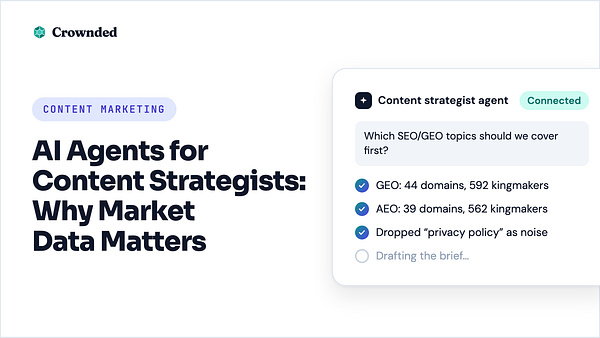
We plan content by turning the market map into a repeatable workflow, and we built Crownded to support that process. In Crownded, a territory groups the competitor domains you want to track. You can then look for opportunities: topics those sites cover that you do not, or cover in more depth than you do.
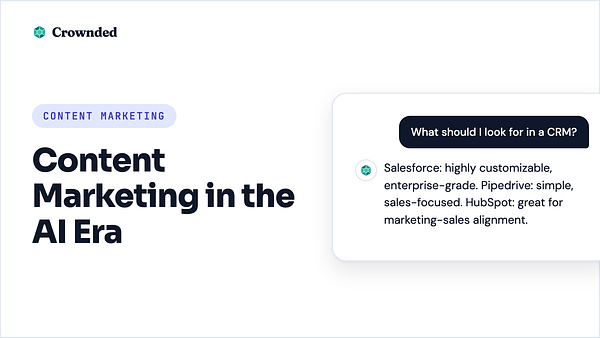
Related queries show questions that LLMs already cite those competitor pages for. That gives you a set of buyer questions to consider, not an instruction to copy existing articles. What LLMs answer matters because buyers now meet brands through AI answers; see our guide to content marketing in the AI era.
From there, a content brief turns selected buyer questions into an article plan. You can test those questions on real LLMs to see what they answer and which sources they cite, then use what you learn to shape the article’s scope and supporting evidence.
This workflow maps the market structure upstream of AI citation monitoring. Monitoring tools measure citation events downstream; they answer a different question from the one this planning process starts with: what are buyers asking, and what answers are already available?
Publishing Is Not Enough: Repurpose Every Blog Article for LinkedIn, Reddit and Newsletters
A new blog has to carry its ideas to readers before readers know to look for it. The article is only half the work: your audience already spends time on established platforms, where people have built habits and trust that a new domain has not yet earned.
Repurposing means adapting one article into smaller pieces that fit the way people use different channels. Start by pulling out its key points and turning them into several LinkedIn posts, each with one clear idea. In a relevant Reddit or community thread, answer the question directly and link to your article only if it adds useful detail. You can also turn the article into a newsletter issue, a short video or a carousel—a set of slides that explains the idea one step at a time.
Don’t paste the same article everywhere; make each version useful on its own. Someone who sees a LinkedIn post or newsletter may never visit the original, so include enough context for them to understand the point without clicking. This also helps when you structure content that LLMs can lift: self-contained passages are easier to understand and reuse.
Choose the format based on the idea, not a quota. A list of practical steps might work as a carousel; a surprising trade-off might make a strong LinkedIn post; a detailed answer could fit a community discussion. Keep a simple record of what you shared, where you shared it and what questions or responses came back. Those replies can reveal what readers want explained next.
Established platforms can carry your ideas while your blog builds its own readership. Over time, the blog becomes a home for the full articles, while adapted versions help new readers encounter them in places they already visit.
The method is to study the market, choose useful questions, plan articles for different reader needs, publish with an audience in mind and carry each piece into the channels that audience already uses. Then keep listening: the next useful topic may come from what readers ask after they encounter your work.