TL;DR
- A content strategy starts with the audience, their needs, the goal and how success will be measured, not with a format or channel.
- Match each piece to the question readers have, whether content finds them in a feed or they search for an answer.
- Use the buyer’s journey to plan useful content for awareness, consideration, decision and retention, while letting readers move between stages freely.
- Keep the key message consistent across platforms, but adapt each format and opening to fit its setting.
- Check that AI summaries carry your intended meaning accurately, not just that they cite your content.
Content Marketing Strategy vs. Tactics: Why AI Answers Only List Tactics
On October 4, 2026, we asked three LLMs (GPT-6 Luna, Claude Sonnet 5 and Gemini 3.5 Flash Lite): “What are the most efficient content marketing strategies?” All three answered with tactics: content repurposing, pillar pages and topic clusters, high-intent SEO content, email newsletters and interactive tools. None started by asking who the audience was, where they were in the buyer’s journey, or what message they needed.
That same day, we asked, “What is the difference between a content marketing strategy and content marketing tactics?” All three explained it correctly: strategy sets who you reach, what they need, the goal and how success is measured; tactics are the formats and channels used to carry it out. Claude Sonnet 5 even warned that jumping straight into tactics is a common mistake. This is one test, an illustration, not a study, but it shows the gap: the distinction is understood, then skipped as soon as someone asks what works.
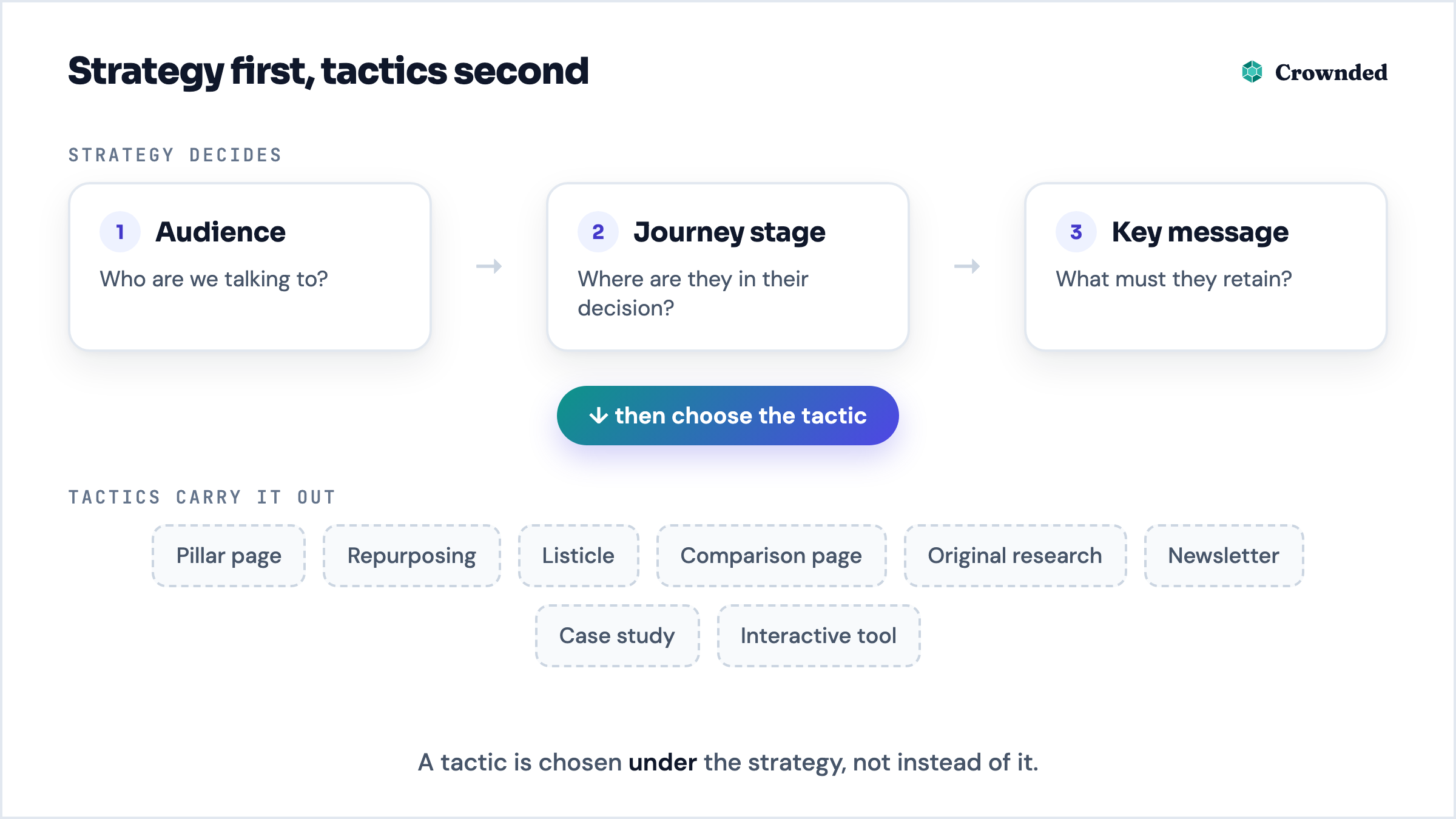
The buyer’s journey is a common framework for the stages people move through: Awareness, Consideration, Decision and Retention. TOFU/MOFU/BOFU (top, middle and bottom of funnel) are shorthand often used for the earlier, middle and later stages. A strategy decides which audience and stage matter, then sets the key message: the central idea a piece should leave with its reader. A content map connects those choices to planned pieces, so each one has a purpose rather than simply filling a channel.
Only then can a tactic be judged as efficient. A pillar page may help people exploring a topic; an email newsletter may deepen an ongoing relationship. Neither is inherently strategic. The same content can travel through owned channels a brand controls, earned channels where others share or cite it, and paid channels it funds, but distribution does not replace a reason to create it.
If you choose the format before the audience, stage and message, you have a production plan, not a content marketing strategy. The formats may still perform, but you have no clear basis for deciding whether they reached the right people or moved them toward the goal.
How Audiences Discover Content: Algorithmic Feeds vs. Active Search
A piece of content must meet one of two discovery conditions: it is pushed into someone’s attention, or they pull it up because they want an answer.
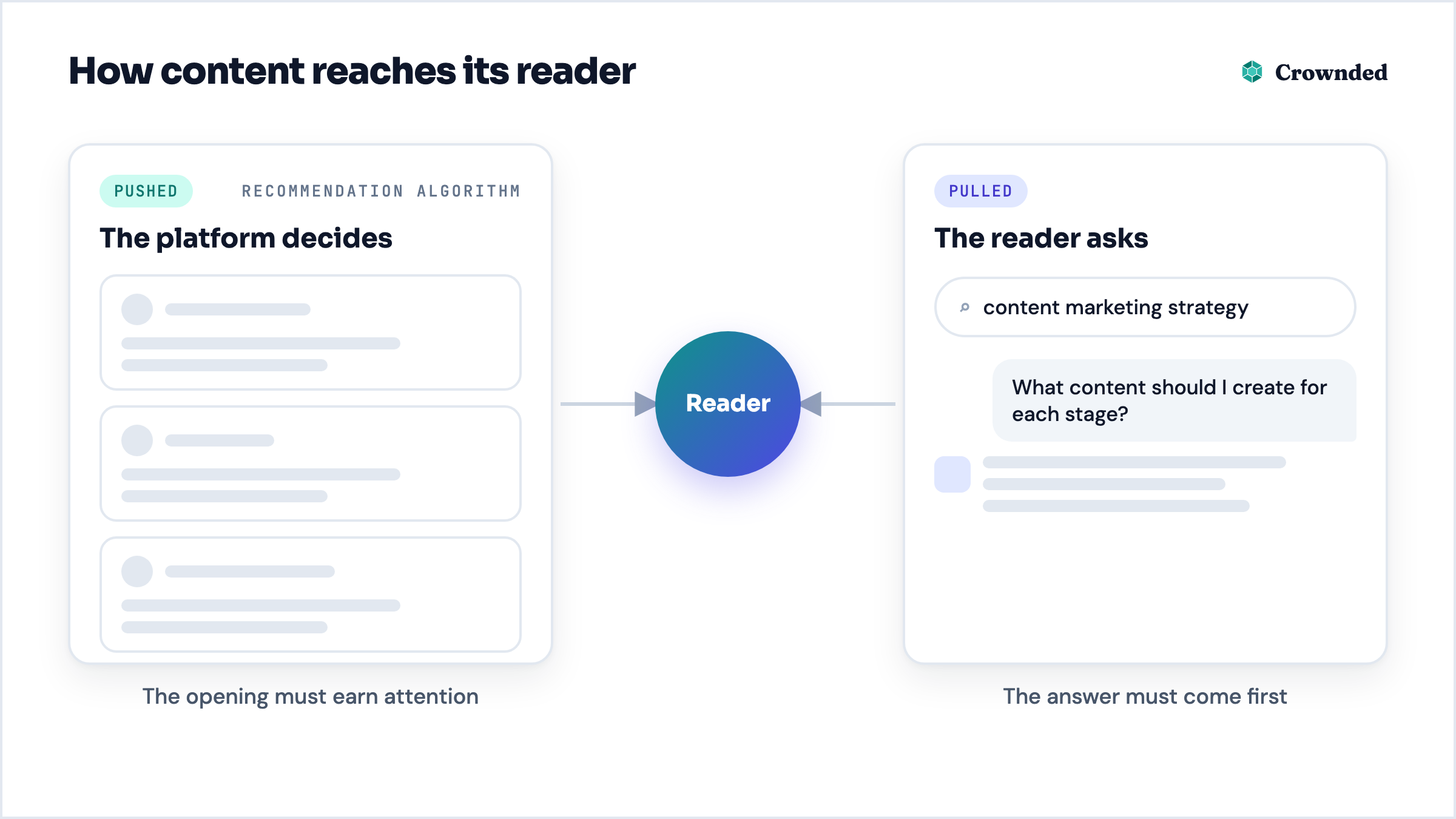
Pushed content arrives through a platform’s recommendation algorithm, whether in a social feed, a video platform or a newsletter digest. The person did not set out to find that particular piece, so the opening has to make its relevance clear before attention moves elsewhere. A sharp observation, a recognizable problem or a useful promise can earn the next few seconds. The format should also suit the setting: a feed may reward a compact idea, while a video can build interest through its first scene or spoken line.
Pulled content meets an expressed need. Someone searches, asks an AI assistant a question or clicks through from a comparison because they are trying to resolve something specific. The piece should answer the question it was found for, early and plainly. A direct heading, a clear explanation and useful supporting detail help readers judge whether they are in the right place; delaying the answer for a broad introduction works against their intent.
The two modes call for different openings, not different standards of usefulness. Pushed content still needs substance after it earns attention, and pulled content still needs a reason for the reader to stay. Shape each piece around how its audience is likely to encounter it, rather than assuming one format or opening will work equally well everywhere.
Most buyers meet a brand through both modes before deciding. A recommendation may introduce an unfamiliar point of view; later, a search or AI question may lead them to a detailed answer. That second encounter should deepen or clarify the first, not feel like an unrelated message.
Content for Each Stage of the Buyer's Journey: Awareness, Consideration, Decision, Retention
A buyer’s journey gives each content piece a job: answer the question someone is trying to resolve at that point, rather than assume every reader needs the same introduction. It is a common framework, not a fixed route through a funnel. Awareness, Consideration and Decision are often labeled TOFU, MOFU and BOFU; Retention continues the journey after purchase.
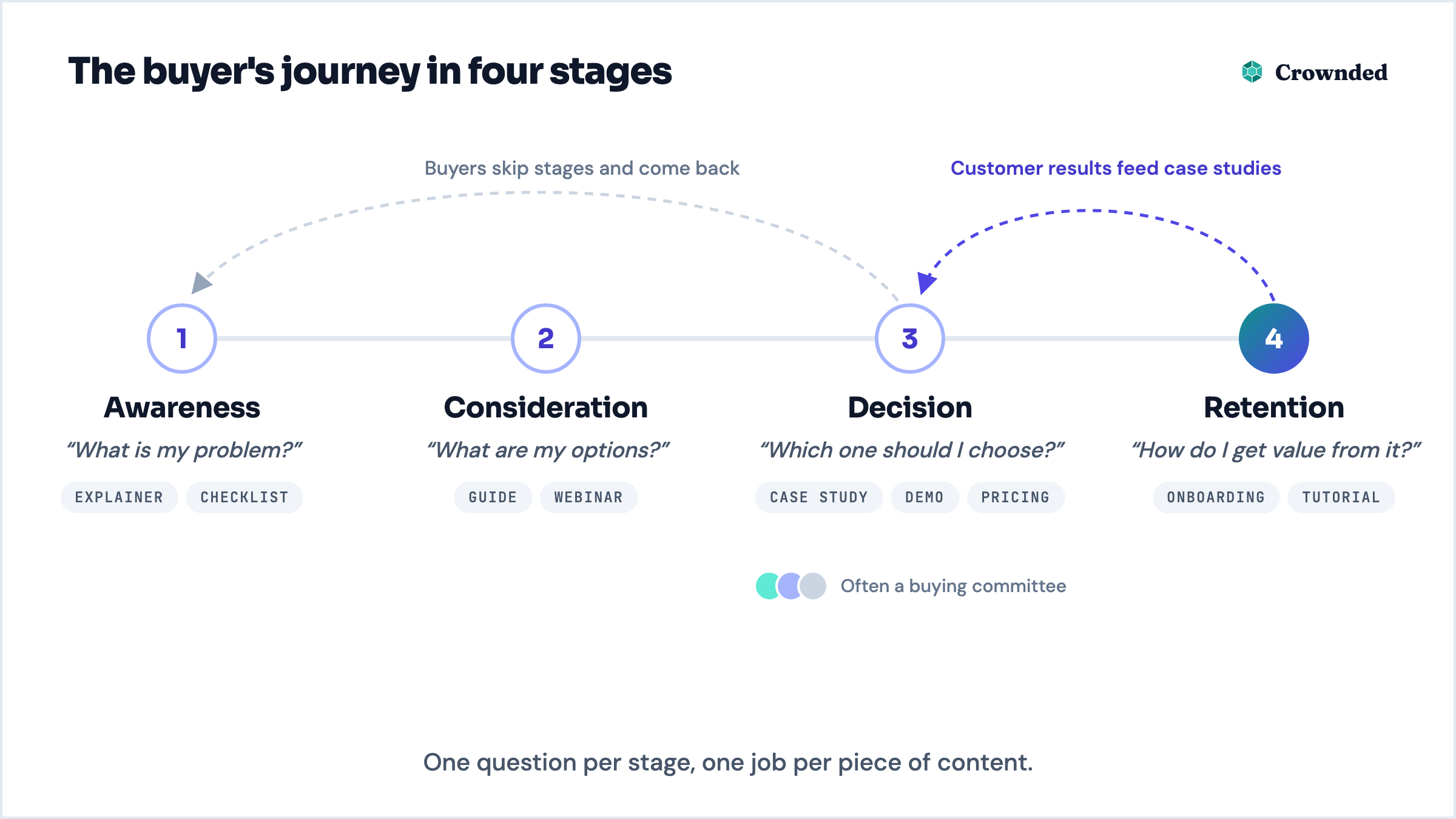
- Awareness: “What is my problem?” People are naming a challenge or trying to understand why it matters. Explainers, checklists and educational posts can clarify the issue, help readers recognize it in their own situation and give them useful language for discussing it. The aim is understanding, not an early pitch.
- Consideration: “What are my options?” Once the need is clearer, people assess possible approaches. Guides, comparisons of approaches and webinars can show how different paths work, what trade-offs they involve and what questions to investigate before choosing. Keep the comparison useful even when your offering is one of the options.
- Decision: “Which one should I choose?” People now need evidence about fit and the practicalities of moving forward. Case studies, demos, pricing pages and implementation pages can show what to expect, who a solution suits and what adoption requires. Make details easy to find so readers can test whether the choice fits their needs.
- Retention: “How do I get value from it?” After purchase, onboarding, tutorials and a well-organized knowledge base help customers use what they bought and solve common problems. Retention content supports customers and can later supply the real-world outcomes and experience that strengthen Decision-stage case studies.
Treat the stages as a planning aid, not a sequence every person must follow. Someone may arrive ready to compare providers, return to basic questions after seeing a demo, or seek implementation details before reviewing a guide. A content map should let people find the answer they need without forcing them through a prescribed order.
In B2B, the “buyer” is often a committee rather than one person. A technical evaluator, budget owner and day-to-day user may all ask different questions at the same stage: one about integration, another about cost, another about workflow. Plan for the concerns of distinct personas within each stage, not just a single generic audience moving through it. That makes the journey useful for deciding which messages and content are missing, while leaving readers free to move between them in their own order.
Content Marketing Tactics Compared: When to Use Them and When Not To
A tactic earns its place when it fits the audience, message and distribution plan, not because it is popular or easy to produce.
LLMs disagree on where listicles belong. In the same series of tests, Claude Sonnet 5 recommended them for top-of-funnel awareness, while Gemini 3.5 Flash Lite pitched them for high-intent, bottom-of-funnel searches such as “best CRM software”. Both can be right: it depends on the question the list answers.
| Tactic | Use it when | Avoid it when |
|---|---|---|
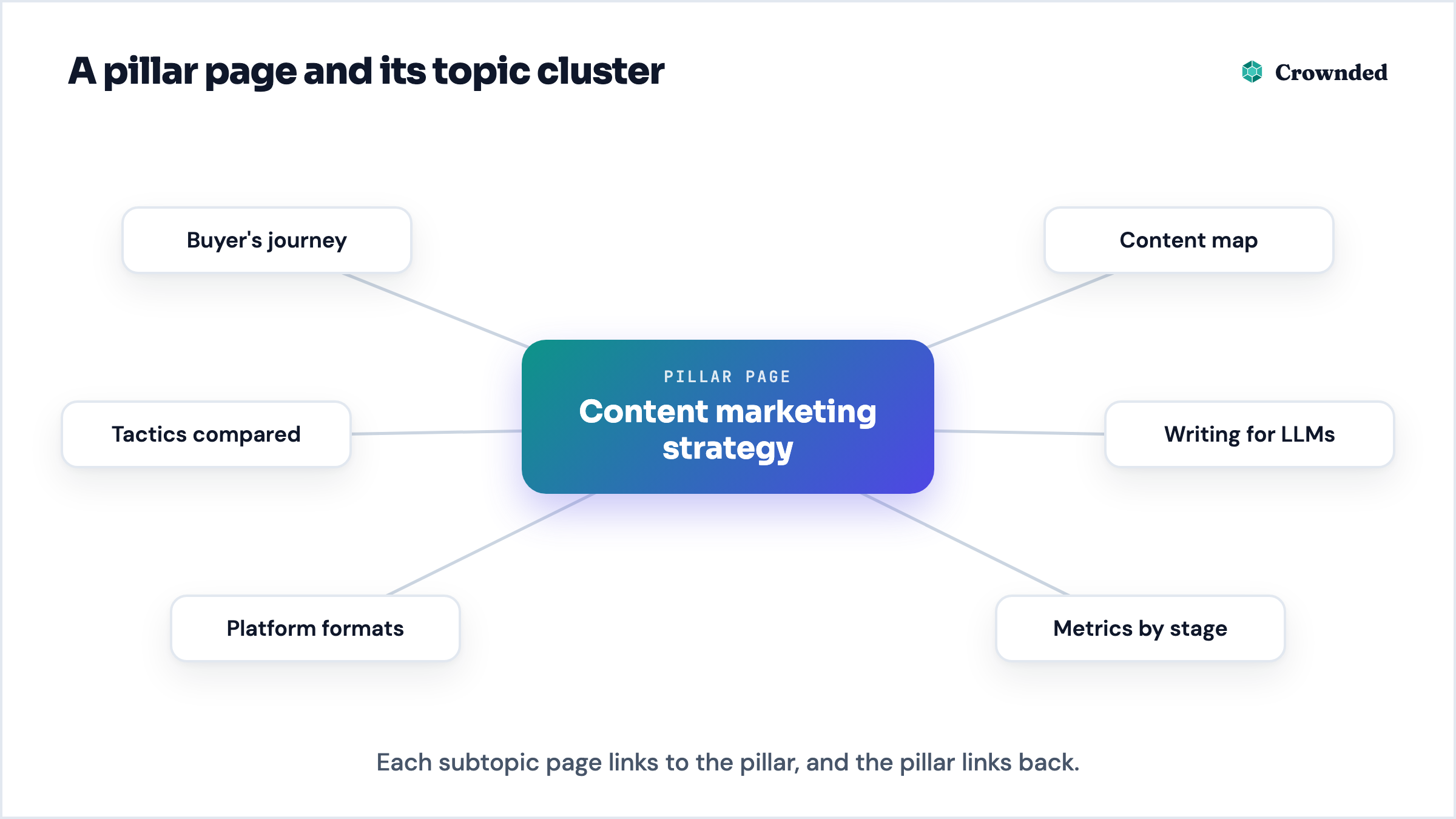
| Pillar pages and topic clusters | A broad core topic matters to your audience and you can cover it in depth, with real subtopic pages linked to it. | The topic is narrow, or you can’t build and maintain the cluster around it. |
| Content repurposing | You have a strong, proven core asset and adapt it to each channel’s native format. | The source material is weak, or the plan is to paste the same text everywhere. |
| Listicles | The subject really is a set of parallel options, tips or tools, and the list answers one clear question. | The list pads thin content to reach a number. |
| Comparison and alternative pages | Decision-stage buyers are weighing named options against each other. | The audience is still at Awareness and doesn’t know the category yet. |
| Original research | You own data or access nobody else has. | You would be rehashing other people’s numbers. |
| Interactive tools and calculators | Your audience repeats the same calculation or diagnosis. | The tool is a gimmick nobody needs twice. |
| Email newsletter | You want an owned channel and have something useful to send at a regular cadence. | You have nothing worth sending each time. |
| Case studies | Decision-stage buyers or Retention-stage customers need a named, concrete result. | The story is vague, with no specific outcome. |
| Updating existing content | A page already attracts readers but its information has aged. | The topic no longer serves your audience. |
The same tactic can be right at one stage and wrong at another, right for one audience and wrong for the next. That is why the tactic comes after the strategy, not before it.
How to Build a Content Map: Message, Format and Channel for Each Stage
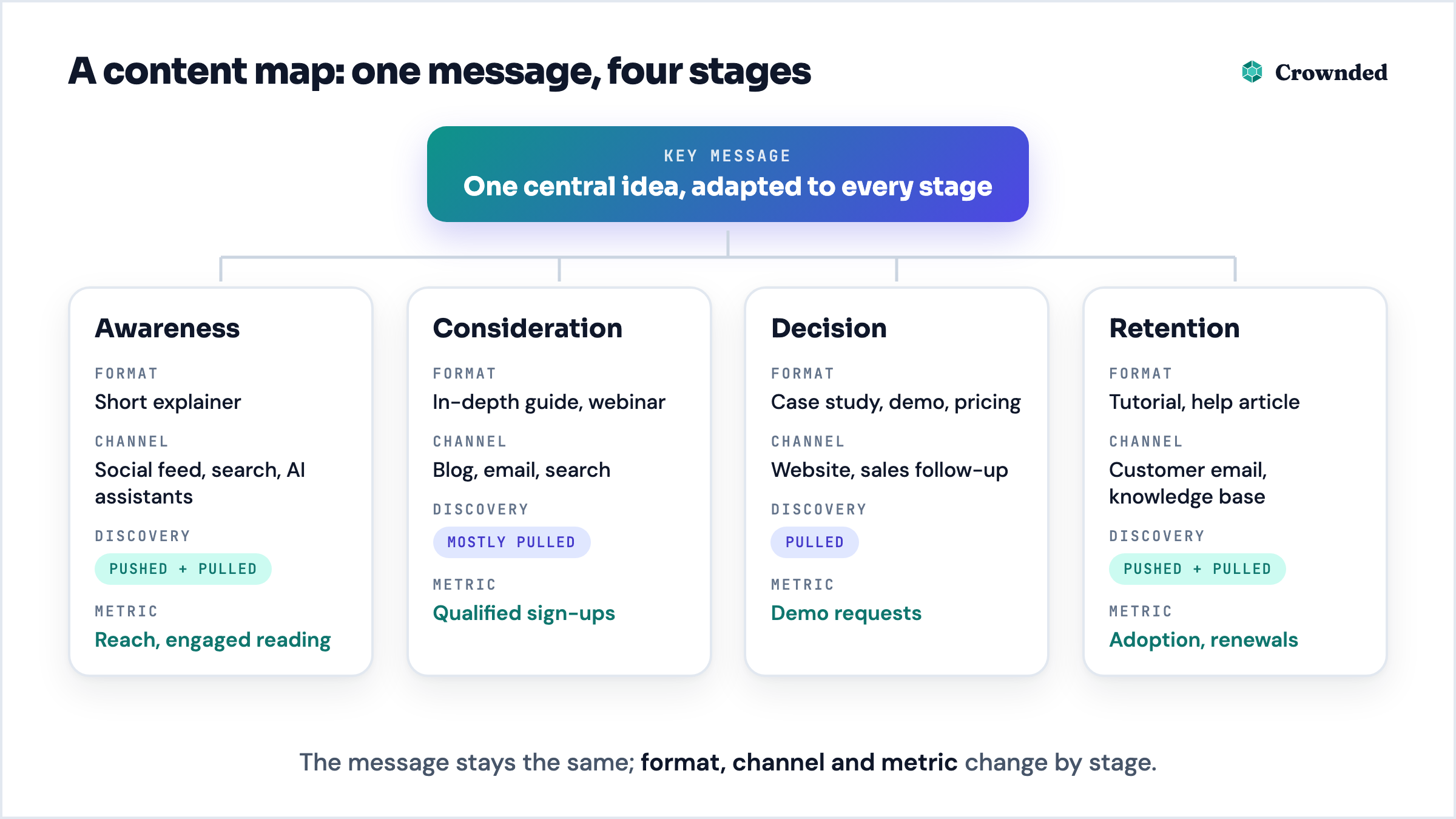
A content map turns the buyer’s journey into a practical brief: start with one audience and one key message, then adapt that message to the question people have at each stage. Keep the central idea consistent while changing the depth, format and channel to fit what readers need.
| Stage | Audience question | Key message | Format | Channel | Discovery mode | Metric |
|---|---|---|---|---|---|---|
| Awareness | What is causing this problem? | The issue has identifiable causes and deserves attention. | Short explainer | Social feed, search, AI assistants | Pushed and pulled | Reach, engaged reading |
| Consideration | What approaches could address it? | There are distinct options, each with trade-offs. | In-depth guide, webinar | Blog, email, search | Mostly pulled | Qualified sign-ups, return visits |
| Decision | Which option fits my needs? | Fit depends on requirements, evidence and implementation. | Case study, demo, pricing page | Website, sales follow-up | Pulled | Demo requests, influenced deals |
| Retention | How can I get more value? | Effective use depends on clear guidance and ongoing support. | Tutorial, help article | Customer email, knowledge base | Pushed (onboarding) and pulled (help) | Adoption, renewals |
Each stage needs its own metric. Awareness content is judged on reach and engaged reading, never on conversions; Decision content is judged on demo requests and influenced deals, not on traffic. Measuring every piece against the same goal makes early-stage content look useless and late-stage content look small.
Then audit what already exists against the map: tag each piece by stage, audience and key message, and fill the gaps that block a stage before producing more. Most content maps list formats per stage; adding the key message and the discovery mode is what turns the map into a strategy.
Writing Content for Two Audiences: Your Persona and the LLMs That Summarize It
Your content now has two readers: the person you want to reach, and the LLMs and platform bots that may interpret it for them. At any point in the buyer’s journey, someone might encounter your brand through an AI answer without ever visiting your site. The model’s summary may become their first impression, and may shape what they understand about your brand before they can judge the original page for themselves.
Writing for both readers does not mean making every page sound like a reference manual. It means making the main point easy to recognize and preserve. Give each section one clear claim. Use headings that name the subject, not vague labels that make sense only after reading the surrounding copy. State important facts with enough context to stand on their own when quoted or summarized. Describe your brand and its work consistently across pages, so a model does not have to reconcile conflicting explanations.
Those choices help people too. A reader scanning a page can find the answer faster; an LLM has a clearer basis for summarizing it. The structuring content for LLM visibility guide covers the page-level mechanics, but structure alone is not the whole test. A citation is not proof that the model carried your key message through accurately. Check whether its answer preserves the point you intended, including what your brand does and for whom. Crownded is one way to check what LLMs say about a page’s content; the broader distinction between a citation and an accurate relay is explored in being cited is not the same as being relayed accurately.
This applies across stages, not only when someone is comparing providers. An Awareness-stage answer can shape how a person names a problem; a Decision-stage summary can affect how they assess fit. Treat the model’s account of your content as part of the reader’s experience, and review it for fidelity, not just visibility. If the summary drops a qualification or blurs your central point, improve the page until the intended meaning is easier to extract.
Why Every New Platform Requires Its Own Content Format
Every platform asks your content to arrive in a different shape. Search engines favor pages that answer a clear query; AI assistants draw on material they can interpret and summarize; social feeds compete for a quick pause; video platforms need a visual or spoken opening; communities reward contributions that fit their conversations; newsletters land in an inbox with a subject line doing the work of an introduction. Each platform applies its own algorithm and conventions, so publishing the same asset everywhere can make the message harder to receive.
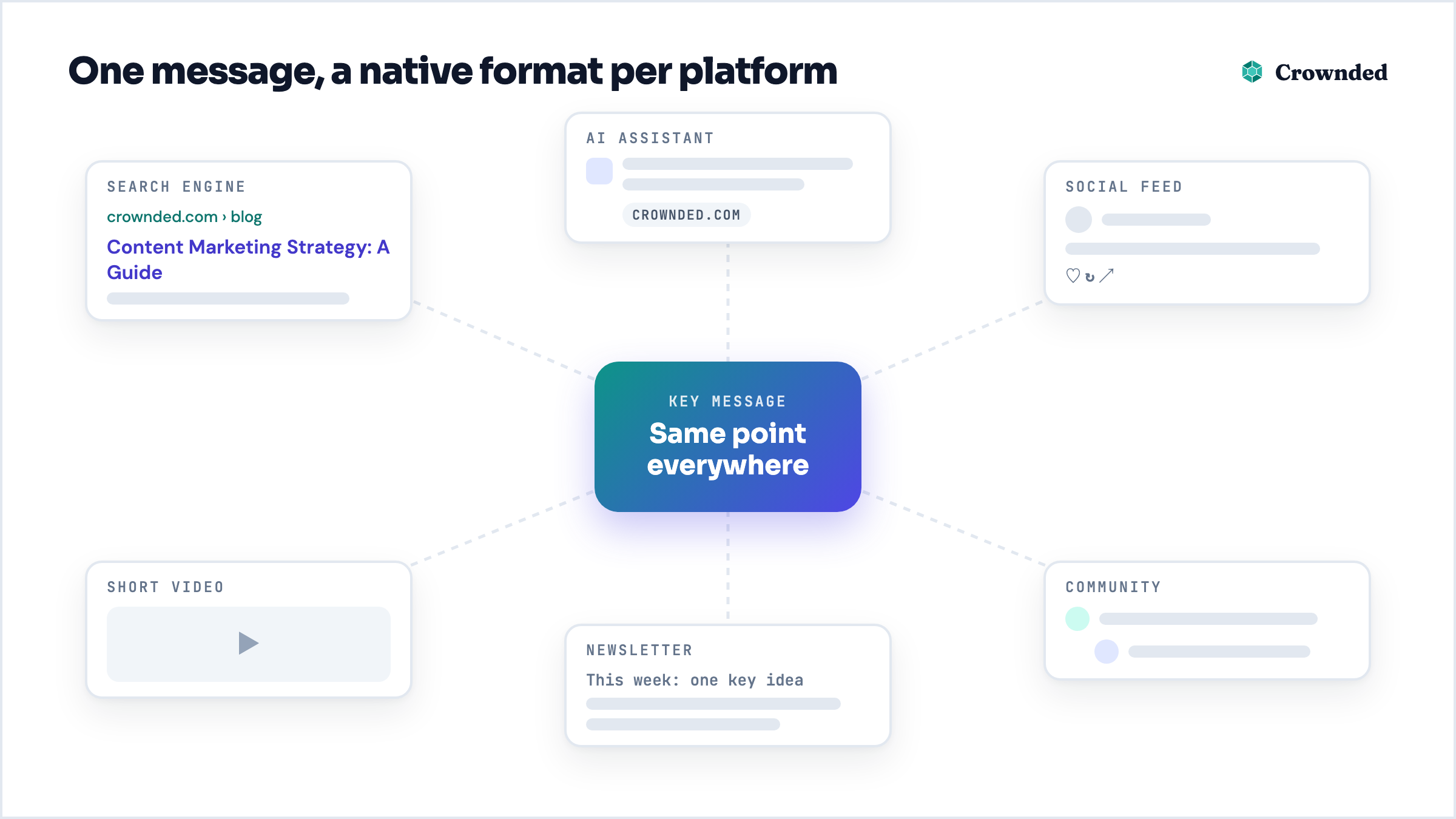
Repurposing is not copying a paragraph into six channels. Keep the key message (the central point you want the audience to retain) consistent, but change the format, length and opening to suit each setting. A detailed explanation on your site might become a concise social post, a spoken video outline, a thoughtful community response or a newsletter note that gives subscribers a reason to read further. Each version should feel native without changing what the brand stands for.
This consistency matters when platforms compress or reinterpret what they find. The content marketing in the AI era article explores how LLMs can end up describing a brand in one line; that description may draw on signals scattered across formats and channels. A single message, expressed clearly in different ways, gives those signals a better chance of pointing in the same direction.
Distribution also changes who controls access. Search, social and video platforms can alter what they surface; email and community are owned channels, where no platform algorithm can switch off your direct connection with subscribers or members. They still require useful content and ongoing trust, but they give a brand a place to maintain relationships as discovery shifts elsewhere.
A content map is therefore a living document: as a new platform changes how people find, discuss or consume information, the map changes with it.